
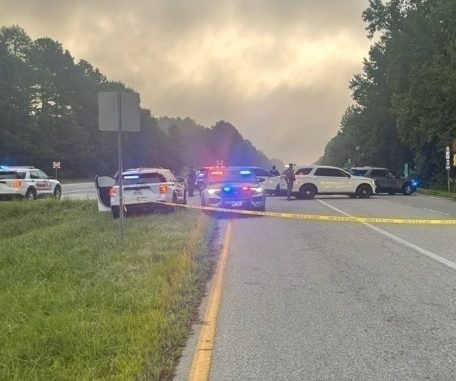
Officers from multiple specialized units have converged on the scene, working in a high-stakes coordination to manage what authorities are officially describing as an “active and potentially life-threatening situation.” The shift from a localized police presence to a major multi-agency emergency response has been swift and jarring, leaving residents, business owners, and commuters struggling to grasp the gravity of the unfolding events.
The Perimeter of Safety: A Community Under Watch
In the immediate wake of the escalation, emergency services acted with clinical precision. A wide, multi-layered perimeter was established, effectively carving out a “frozen zone” within the heart of the district. This boundary was designed with a singular purpose: to secure the area and prevent any unauthorized access that could complicate the tactical resolution or lead to civilian casualties.
The logistical impact has been massive:
-
Road Closures: Major arterial roads have been blocked by heavy-duty police cruisers and portable barriers, creating a gridlock that extends for miles.
-
Transit Diversions: Public transportation routes, including bus lines and light rail services, have been diverted or suspended entirely, leaving thousands of travelers to seek alternative routes.
-
Restricted Entry: Every entry point is being strictly monitored by armed personnel. Only essential medical and tactical personnel are being granted access to the restricted zone.
Officials have been quick to emphasize that these measures are not an overreaction. “The directive for civilians to remain clear is rooted in a fundamental commitment to the preservation of life,” a department spokesperson stated during a brief press conference. The goal is to minimize any potential risk while the variables of the situation remain volatile and unresolved.

The Transformation of the Urban Landscape
The physical transformation of the affected area has been both immediate and striking. A neighborhood that, only hours ago, was an ordinary and predictable urban environment has been reshaped into a highly controlled, militarized security zone. The presence of law enforcement is impossible to ignore; it has become the defining feature of the landscape.
Dozens of specialized vehicles now line the streets, forming a visible and imposing barrier. Standard patrol cars have been supplemented by:
-
Armored Tactical Vehicles: Designed to provide cover for officers moving into high-risk positions.
-
Mobile Command Centers: Large, bus-like vehicles equipped with satellite arrays and advanced surveillance technology to provide real-time intelligence to commanders.
-
Emergency Medical Units: Staged at the edge of the perimeter, ready to respond the moment a resolution is reached.
The coordination among these diverse units reflects a high level of preparedness. It is a visible demonstration of the “incident command system,” a structured approach designed to handle complex, rapidly changing circumstances where a single mistake could have catastrophic consequences.

A Landscape of Red and Blue: The Atmosphere of Crisis
As evening approaches, flashing emergency lights have begun to dominate the visual landscape. The steady, rhythmic strobing of red and blue reflects off glass office buildings, wet asphalt, and the faces of nervous onlookers. This visual saturation creates an atmosphere that feels both urgent and surreal—as if this specific portion of the city has been temporarily removed from the flow of normal time.
The usual sounds of daily life—the hum of traffic, the chatter of pedestrians, the distant sound of construction—have been replaced by a new and unsettling soundscape:
-
Tactical Radio Bursts: The static-filled chatter of officers coordinating their movements.
-
Intermittent Sirens: As new units arrive to reinforce the perimeter.
-
The Whirr of Rotors: As police helicopters circle overhead, providing an eye-in-the-sky perspective for the command staff below.
For those observing from the safety of the perimeter, the scene serves as a stark reminder of the thin line between routine and emergency. The visual and auditory cues all point toward a situation of the utmost seriousness.